
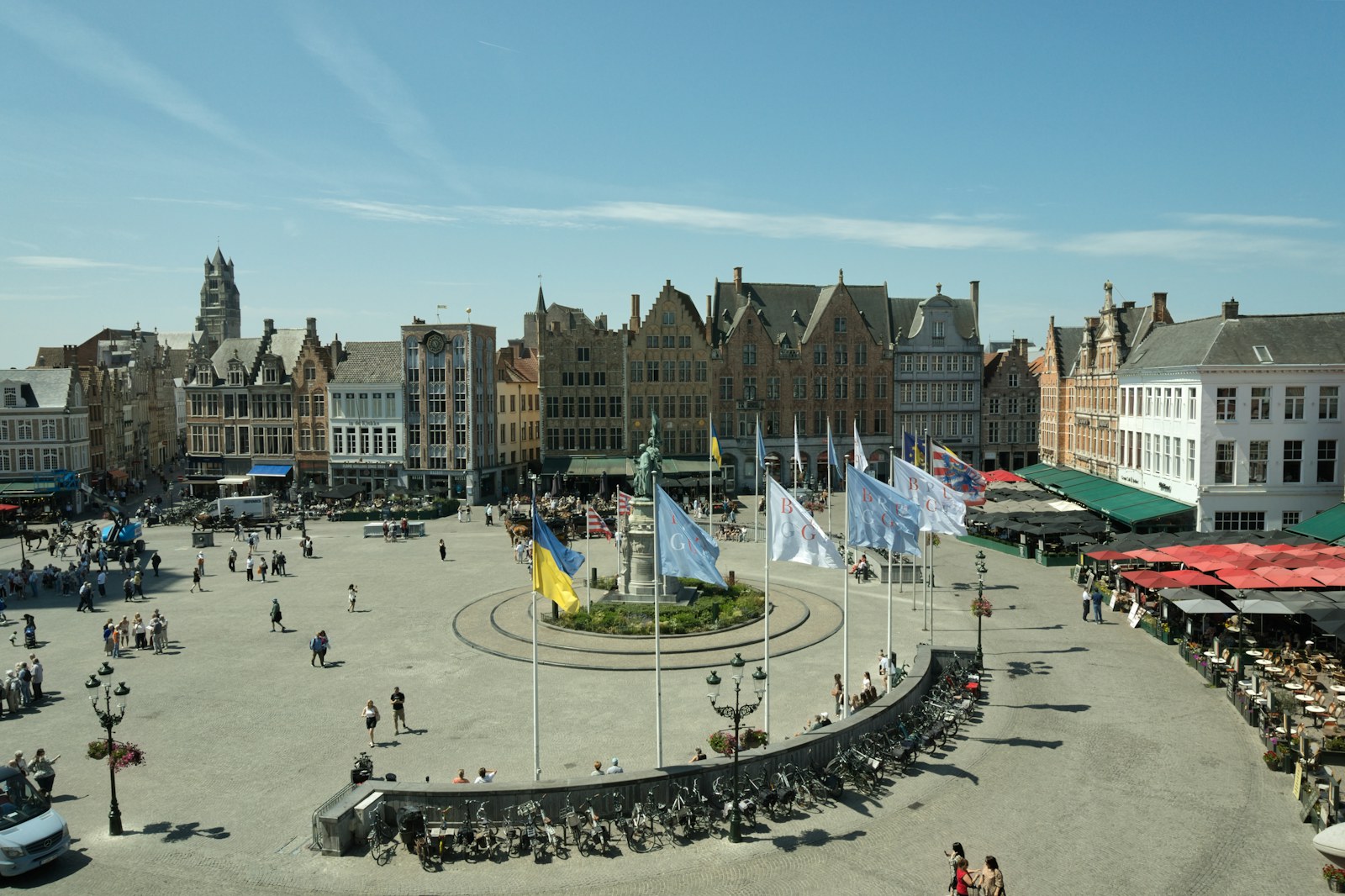
The Athora Bruges Marathon 2026 takes place on Sunday 11 October, with the marathon and half marathon starting together at 10:00 on 't Zand and finishing on Grote Markt. That city-centre start and postcard finish make the event unusually easy to build into a weekend in Bruges — but they also make accommodation, transport and race-morning timing worth sorting out before you arrive.
The essentials are already published. Bib collection opens the day before, free sports-bag storage is included, showers are provided after the race, and the marathon has a six-hour time limit. The detailed 2026 course map and supply-station plan are still being finalised, so an old route map is not a reliable substitute.
Quick answer
- Race day: Sunday 11 October 2026.
- Marathon & half marathon start: 10:00 at 't Zand.
- Family Walk start: 10:45.
- Finish: Grote Markt.
- Bib collection: Saturday 10 October, 12:00–17:00; Sunday 11 October, 08:00–10:45.
- Personalised bib deadline: register online by 21 September 2026.
- Registration closes: 10 October at 23:59, unless the event sells out first.
- Marathon time limit: 6 hours.
- Bag storage: free sports-bag storage is included; it closes at 17:30.
- Changing rooms & showers: included. The practical-info section currently lists Sint-Leo Hemelsdaele, Potterierei 11, while the organiser's location summary still says the final shower/changing-room location will be announced later.
- Detailed 2026 route and supply stations: still to be published.
What is confirmed about the 2026 route?
The organiser has confirmed the two points that matter most for race-weekend logistics: the start is on 't Zand and the finish is on Grote Markt. The course has also been officially measured by World Athletics.
What is not yet public in enough detail is the full 2026 course description, route map and supply-station layout. The event website has a course section, but the detailed runner information still says those course and refreshment details will be published later.
That matters because the 2025 marathon used a route through central Bruges, out towards Damme and back through the southern side of the city. It is useful background, not a promise that every street will be identical in 2026. If you are choosing a spectator point or planning to meet a runner away from the start and finish, wait for the 2026 course rather than building the day around last year's map.
Race-day timetable
The current programme is straightforward:
- Saturday 10 October, 12:00–17:00: bib collection;
- Sunday 11 October, 08:00–10:45: bib collection;
- 10:00: marathon and half marathon start;
- 10:45: Family Walk start;
- 16:45: finish line closes;
- 17:30: event ends; sports-bag storage and the food market close.
The organiser notes that timings can still change. For a marathon runner, however, the practical lesson is already clear: collecting your bib on Saturday gives you a calmer Sunday morning, especially if you want breakfast, a warm-up and an unhurried walk to 't Zand.
Bib collection and the 21 September deadline
Race packs are not mailed in advance. At least one week before the event, individually registered runners receive a confirmation email containing either their personalised bib number or an e-ticket, which is then used to collect the pack on site.
Register online by Monday 21 September if you want your first name printed on the bib. That is also the key deadline for several group-registration and participant-change options. After 21 September, name changes move to the on-site registration desk and cost €12; changing to a longer distance is then subject to availability.
Registration itself can remain open until Saturday 10 October at 23:59, but only if places remain. That caveat is worth taking seriously: the 2025 edition sold out for the first time, with 12,000 participants across the marathon, half marathon and Family Walk.
Registration is handled directly by the Athora Bruges Marathon organiser.
Bag drop, changing rooms and showers
Free sports-bag storage is included for runners. Your bag receives a numbered sticker and you receive the matching sticker for your bib; you need that match to collect the bag afterwards.
Use a fully closable sports bag. Loose clothing and plastic bags are not accepted, and the organiser advises against leaving valuables such as a phone, watch, wallet, cash or keys inside. Storage is supervised, but it is still used at your own risk.
The exact bag-drop point has not yet been published. The current programme does confirm that bag storage closes at 17:30.
Changing rooms and showers are included, but the organiser's current practical page is internally inconsistent about the final location. Its dedicated changing-room section lists Sint-Leo Hemelsdaele, Potterierei 11, around 1.3 km from the start and 900 metres from the finish, while the location summary higher on the same page says the exact shower and changing-room point will be announced later. If you need to catch a train or make a fixed reservation soon after finishing, keep some margin until the final runner information settles that location.
Time limits and pacing
The marathon has a six-hour limit. Roads reopen behind a six-hour pace; runners who fall behind that schedule are removed from the race and, if they continue, do so under normal traffic rules and at their own risk.
For the half marathon, roads reopen behind the final runner according to a schedule based on 7 minutes per kilometre.
The marathon also has official pacers currently listed for 2:59, 3:15, 3:30, 3:45, 3:59, 4:15, 4:30, 4:45 and 5:00. Starting-zone details are still to come, so choose your target pace now but leave the exact corral logistics until the organiser publishes them.
Getting to Bruges for the marathon
For many runners from Brussels or arriving internationally through Brussels, train is the simplest option. Our Brussels to Bruges by train guide explains which Brussels station to use, current ticket rules and the final arrival at Brugge station.
Brugge station, 't Zand and the historic centre sit close enough together that a runner staying centrally can usually manage race weekend without a car. If you are arriving from another airport or city, Getting to Bruges compares the wider options.
The event organiser specifically discourages driving into the historic inner city and points runners towards Park & Ride. If you do come by car, our Bruges parking guide is more useful than trying to navigate directly to the start.
Where to stay for race weekend
For this event, location is more important than chasing a particular hotel brand.
Around 't Zand
This is the easiest base for the start and food market. You can leave the hotel shortly before you need to be in the start area, and you avoid relying on a bus, taxi or car on a morning when central streets are affected by the race.
Between 't Zand and Markt
For runners travelling with a partner or family, this is arguably the best compromise. The runner remains close to the start, while companions are already in the historic centre and can reach the Grote Markt finish without turning the morning into a transport exercise.
Near Brugge station
The station area makes sense if you are arriving late on Saturday, leaving soon after the event or prioritising an easy rail connection. It gives up some of the medieval-centre atmosphere, but the walk to 't Zand is manageable and you remove one layer of stress from arrival and departure.
If the marathon is part of a couples' weekend rather than a pure race trip, our romantic hotels in Bruges guide compares central properties by atmosphere and location. For race morning, always check the walking route to 't Zand rather than judging distance from the hotel name alone.
A practical plan for Saturday
If you can, arrive by mid-afternoon on Saturday.
- Check in and collect your bib before 17:00. That removes the biggest avoidable task from race morning.
- Walk from your hotel to 't Zand. Knowing the route in daylight is more useful than discovering it while half awake on Sunday.
- Keep dinner simple and book early if you have a specific restaurant in mind. A major event weekend can make the centre busier than a normal October Saturday.
- Prepare a closable bag if you intend to use the free storage.
- Check the final event email for the exact bib-collection point, bag-drop point, shower/changing-room location, starting zones and any course information published after this guide's latest factual check.
A practical plan for Sunday
If your bib is already collected, build the morning backwards from the 10:00 start rather than from hotel breakfast hours. Leave enough time to eat, dress, walk to 't Zand, use any facilities you need and enter the appropriate starting area without rushing.
If you still need your bib, collection opens at 08:00. Do not treat the 10:45 closing time as a sensible target for a 10:00 race start.
After finishing on Grote Markt, decide whether you actually need the showers before heading back towards your hotel or the station. If Potterierei 11 remains the final shower location, it is a separate walk from the finish, while bag storage and the food market remain open until 17:30.
What companions should know
The start and finish being in different central squares is good news for spectators: there is no need to follow the whole course to be part of the day. A companion can see the start around 't Zand, spend time in the centre and then move towards Grote Markt for the finish.
The detailed 2026 route will make intermediate spectator planning much easier once published. Until then, avoid promising to meet at a point borrowed from the 2025 course — especially outside central Bruges.
What can still change before 11 October?
The core plan is firm enough to organise travel now: 11 October, 10:00 marathon/half-marathon start, 't Zand start, Grote Markt finish, Saturday/Sunday bib collection, free bag storage and post-race changing rooms/showers.
The remaining moving pieces are the detailed 2026 course, supply stations, exact bib-collection and bag-drop locations, the final shower/changing-room location, starting-zone instructions, final traffic information and whether registration sells out. Those details matter most to runners and spectators with a precise race-day plan; they do not prevent you from choosing transport and accommodation now.