
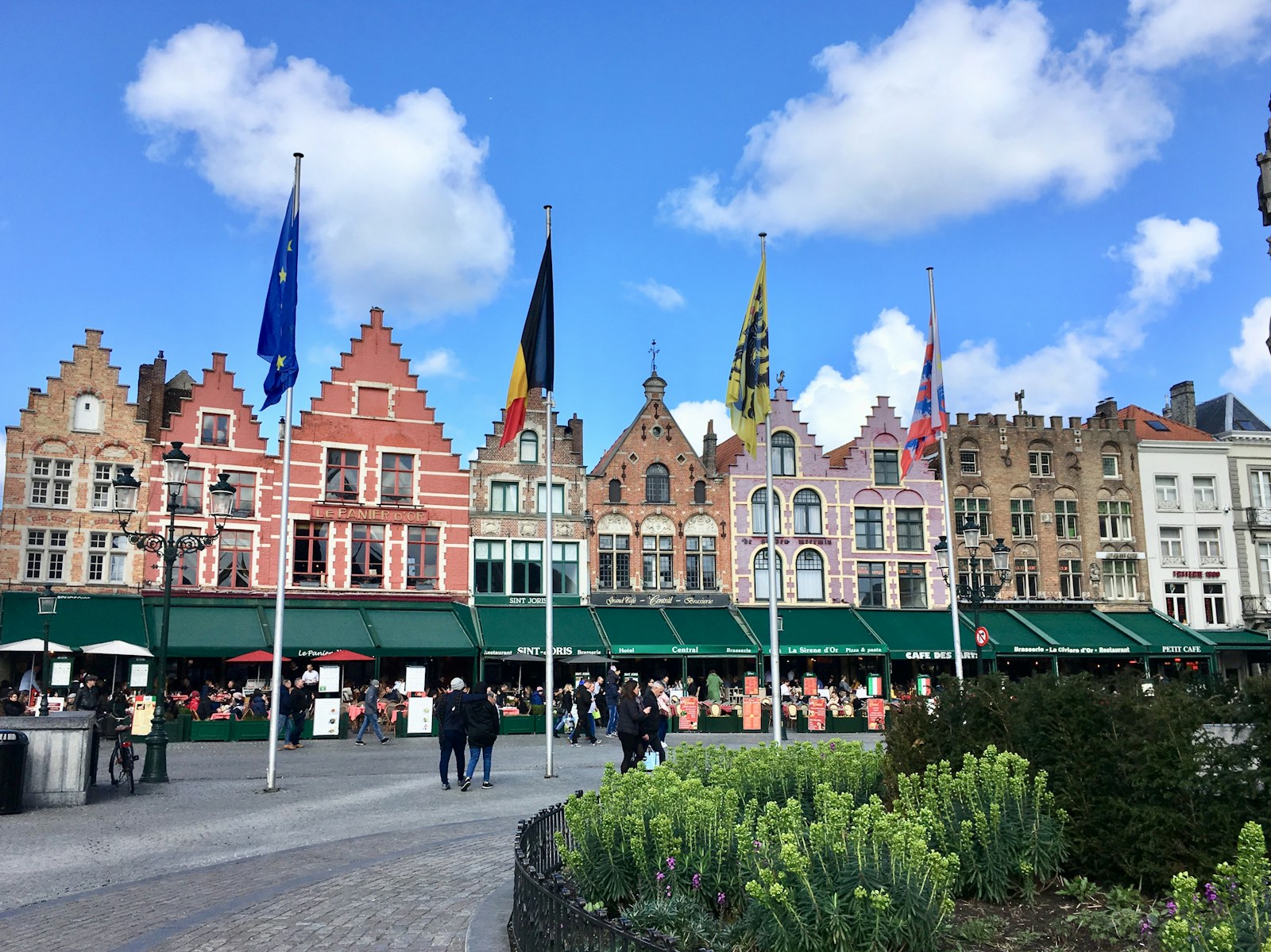
Bruges is compact, beautiful and more accessible than its medieval appearance may suggest — but it is not uniformly easy. Cobbles, small kerbs, steep bridges and protected historic buildings still matter, especially with a manual wheelchair, limited stamina or balance difficulties. The best visit is built around the city's official accessible route, a few carefully chosen venues and enough margin to change course when a street or doorway demands more effort than expected.
Visit Bruges has a 3.8 km mapped accessible walk that can be shortened, with obstacle notes rather than a vague promise of step-free sightseeing. It links the station side of the centre with major sights and also documents toilets, accommodation, places to eat, care facilities, transport and parking. That makes it a much better backbone for the day than simply following the shortest route between landmarks.
Quick answer
- Best planning tool: the official Bruges, accessible for everyone guide and its detailed online route.
- Official accessible walk: about 3.8 km, with shortcuts and obstacle information.
- Train assistance: free at Brugge station when booked under SNCB/NMBS conditions.
- Easier major museums for wheelchair users: Groeningemuseum, Museum Sint-Janshospitaal, O.L.V.-kerk Museum, O.L.V. ter Potterie, Gezellehuis, the pharmacy at Sint-Janshospitaal and City Hall; BRUSK is also designed with wheelchair access, lifts and accessible toilets.
- Poor choices for a wheelchair visit: the Belfry tower, Gruuthusemuseum and Sint-Janshuismolen require stairs.
- Best care facility in the centre: the Changing Place at the Provincial Court on Markt, with an adult changing table and hoist.
- Wheelchair hire: available in the centre from Bike Rental Koffieboontje and Pharmacy Fevery-Dewitte.
- Adapted taxis: specialist wheelchair transport is available; Taxi Hendriks asks for at least 24 hours' advance booking.
- Reality check: the most famous route is not always the easiest route. Small detours can save significant effort.
Start with the accessible route, not the sightseeing checklist
The official route starts on the station side of the centre and works through Bruges with measured details about surfaces, kerbs, gradients and narrow sections. Around 't Zand and Zuidzandstraat, for example, the route points out where level surfaces give way to small kerbs; around Markt it explains the relatively manageable mosaic cobbles but also flags awkward details such as kerbs and narrow or steep side streets.
This is the right way to think about Bruges. A route that is 150 metres longer but avoids a rough bridge or deep cobbles can be the better route. If you use a manual wheelchair, rollator or walking aid, treat the official walk as a framework rather than a challenge to complete from beginning to end.
The historic centre also rewards stopping. Benches, cafés, accessible toilets and museum seating should be part of the plan before fatigue arrives, not emergency solutions afterwards.
Arriving by train
Brugge station offers free assistance for passengers with reduced mobility, with lifts to the platforms, adapted toilets and reserved parking spaces. SNCB/NMBS permits assistance requests up to 3 hours before departure for certain direct journeys between participating stations; journeys involving connections or other stations generally require more notice. Follow the conditions shown for your exact journey and arrive at the agreed meeting point in good time.
Use SNCB/NMBS for the assistance request and current rail conditions. Brugge is the main station for the historic centre; Brugge-Sint-Pieters is not the station most visitors want.
From the station, the centre is close but the surface changes matter. If saving energy is more important than walking every metre, buses can shorten the first part of the journey. Our getting to Bruges guide covers the wider arrival options.
Buses, taxis and saving energy
De Lijn buses connect the station with the centre. The official accessibility material identifies the station, Church of Our Lady and Stadsschouwburg stops as independently accessible for wheelchair users and for blind or partially sighted travellers; 't Zand is wheelchair accessible. Most newer buses have low floors, ramps, kneeling systems and reserved spaces.
For travellers who find communication difficult, BlueAssist can help communicate a request to a driver or fellow passenger using cards or a smartphone.
For door-to-door transport, Bruges' accessibility guide lists adapted taxi services. Taxi Hendriks specialises in wheelchair transport and asks for at least 24 hours' advance reservation. A taxi is not only for travellers who cannot walk: it can be a sensible way to preserve energy between the station, hotel and historic centre.
Museums and monuments: choose the building, not just the attraction
Bruges' museum network includes protected monuments, so accessibility changes sharply from one site to another.
Stronger choices for reduced mobility
Musea Brugge lists Groeningemuseum, Gezellehuis, O.L.V.-kerk Museum, O.L.V. ter Potterie, the pharmacy and Museum Sint-Janshospitaal, and City Hall as wheelchair-accessible locations. Staff can assist where needed.
BRUSK is one of the easiest major cultural choices: it has wheelchair access, lifts and accessible toilets, plus a modern layout that avoids many of the compromises found in older buildings.
At Groeningemuseum and Museum Sint-Janshospitaal, wheelchairs can be reserved for a half-day. The Groeningemuseum chair is a push wheelchair and requires a companion. Lightweight folding chairs are also available at several museums, and most Musea Brugge locations provide resting points.
If you cannot visit independently, a necessary companion is admitted free of charge at Musea Brugge.
Places that require more compromise
The Belfry tower is reached only by steep stairs and is not a wheelchair visit. The accessible parts around the complex and an adapted toilet can still be useful, but the 366-step tower itself is a different proposition.
Gruuthusemuseum is also reached by stairs and the museum route is not wheelchair accessible, although it has useful provisions for other needs: tactile stations, descriptive audio, tactile paving from the bus stop, a tactile model, text versions of audio content and sensory kits.
Sint-Janshuismolen likewise requires steps. The Brugse Vrije has three steps, although a retractable ramp can be used with assistance.
The practical rule is simple: if one museum matters a lot to you, check that specific building rather than assuming the whole Musea Brugge network works the same way.
Visual, hearing and sensory access
Accessibility in Bruges is broader than wheelchair access. The Visit Bruges guide is available in a screen-reader-friendly online format, while individual museums publish specific support.
Examples include tactile models and descriptive material, hearing protection for the Belfry carillon, text versions of audio tours at City Hall and Gruuthusemuseum, and sensory kits at Gruuthusemuseum. Guide dogs are welcome in venues participating in the city's accessibility arrangements.
For people who find crowds, noise or rapid decision-making difficult, the timing of the day can matter as much as the building. Markt is calmer early; a quieter pause away from the busiest shopping streets can make a substantial difference. Build one or two low-pressure alternatives into the day rather than forcing every planned stop.
Accessible toilets and the Changing Place on Markt
The most important care facility in central Bruges is at the Provincial Court (Provinciaal Hof), Markt 3. Its Changing Place includes an adapted toilet, washbasin, adult changing table, privacy screen and hoist, with enough room for the user and up to two assistants or carers. Accessible lifts serve the floors of the restored building.
Brugge station also has adapted toilets, and the official accessibility guide identifies additional facilities around the centre.
This is worth planning in advance if an ordinary accessible toilet is not enough: Markt is central enough to act as a reliable care anchor during a sightseeing day.
Wheelchair and mobility-equipment hire
The official accessibility guide lists two central places where a wheelchair can be borrowed:
- Bike Rental Koffieboontje, Hallestraat 4;
- Pharmacy Fevery-Dewitte, Zuidzandstraat 1.
Equipment availability can change, so reserve or contact the provider before relying on it. The guide also lists mobility-equipment services outside the immediate centre and a wheelchair-bike option through Curando in Sint-Kruis.
Where to stay: useful accessibility beats a romantic façade
For accommodation, do not stop at the word “accessible”. Ask about the whole chain from pavement to bed: entrance threshold, lift, corridor width, room access, bathroom transfer space, shower, bed height and evacuation arrangements.
Visit Bruges links many properties to detailed Visit Flanders accessibility records. Current examples include:
- Hotel de' Medici, which publishes three specially adapted rooms, an adapted lift and independently accessible room access;
- Snuffel Hostel, with independently accessible entrance and rooms, adapted lift and independently accessible adapted toilet;
- Crowne Plaza Brugge, with independently accessible entrance and documented adapted facilities;
- Dukes' Arches, with independently accessible entrance but room access described as accessible with assistance.
These are examples, not a universal ranking. The best hotel is the one whose measurements and assistance level match your own needs. In Bruges, a practical location beside a usable bus stop can also be more valuable than a picturesque canal address reached over difficult surfaces.
Eating and drinking: check the entrance and the toilet separately
Restaurants and cafés are the fastest-changing part of the accessibility guide, so treat the official measurements as a shortlist rather than a permanent guarantee.
The detailed Visit Bruges accessibility guide includes useful examples. Concertgebouwcafé is listed with step-free entrance, a 90 cm door and tables that a wheelchair can fit under. Duvelorium on Markt is listed with step-free access, a wide entrance and a comparatively spacious adapted toilet. Other cafés may have a usable entrance but a toilet that is too narrow, lacks support rails or cannot be reached independently.
That distinction matters. “I can enter” and “I can comfortably use the toilet” are two different questions. If a meal is a fixed part of your day, confirm the feature that matters to you rather than asking only whether the restaurant is “wheelchair accessible”.
Parking with a disability card
Bruges has reserved spaces for disabled visitors, and the city's accessibility material points to navigeerenparkeer.be for mapped information including surface, dimensions and photographs of individual bays.
If you are coming by car, combine that information with our Bruges parking guide. A reserved bay closest to a landmark is not automatically the easiest option if the route from the bay crosses difficult paving or a bridge.
Guided visits and companions
For a guided visit, ask for more than the label “accessible tour”. The useful questions are: What surfaces are used? Are there steps? Can the route be shortened? Where are the toilets? Can the guide alter the pace? Is there somewhere to sit?
The European Disability Card is recognised by the City of Bruges, although benefits vary by venue. Where a companion is necessary for you to make the visit, Bruges' accessibility guidance states that the personal companion can enter participating venues free of charge; check the conditions of the specific attraction when planning a paid visit.
A realistic accessible day in Bruges
A good plan does not need to cover everything.
- Arrive with rail assistance arranged if you need it, and decide in advance whether the bus or taxi is a better use of your energy than walking from the station.
- Follow the official accessible route towards 't Zand, the museum quarter and the central squares, using its shortcuts when needed.
- Choose one major indoor visit whose access fits you. BRUSK, Groeningemuseum, Sint-Janshospitaal or City Hall are stronger wheelchair options than the Belfry tower or Gruuthusemuseum.
- Use Markt as a practical anchor, especially if the Provincial Court Changing Place is relevant to you.
- Build in a real seated break before deciding whether to add a second museum or another part of the route.
- Keep one alternative. In a medieval city, one unexpected threshold, temporary work zone or crowded street should not be allowed to ruin the whole day.
Bruges does not become accessible by pretending its cobbles and historic buildings are effortless. It becomes much more enjoyable when you know where the difficult sections are, choose the right venues and spend your energy on the parts of the city you actually came to see.