Bruges is not the easiest Belgian city for a traveller with coeliac disease, but there are good options if you know where to look. The important distinction is between a product that contains no gluten ingredients and a kitchen that can explain how it handles flour, shared waffle irons, fryers, utensils and crumbs.
The strongest choices include a specialist waffle stop, restaurants willing to plan a meal in advance, a second gluten-free waffle option, a chocolatier with unusually clear allergen information and a surprisingly varied Belgian gluten-free beer scene. None of those removes the need to discuss cross-contamination when it matters to you.
For the broader food context, compare this guide with traditional food in Bruges and our separate vegan and vegetarian guide.
What “gluten-free” means in Belgium
Belgian food businesses must make information about fourteen regulated allergens available for non-prepacked food. Under European rules, the expression “gluten-free” is reserved for food containing less than 20 mg/kg of gluten.
That threshold describes the food; it does not automatically tell you how a restaurant prevents accidental contact during preparation or service. If you have coeliac disease, say so clearly rather than asking only whether a dish “has gluten”. Menus, recipes and kitchen procedures can change.
Otto Waffle Atelier: the clearest sweet stop
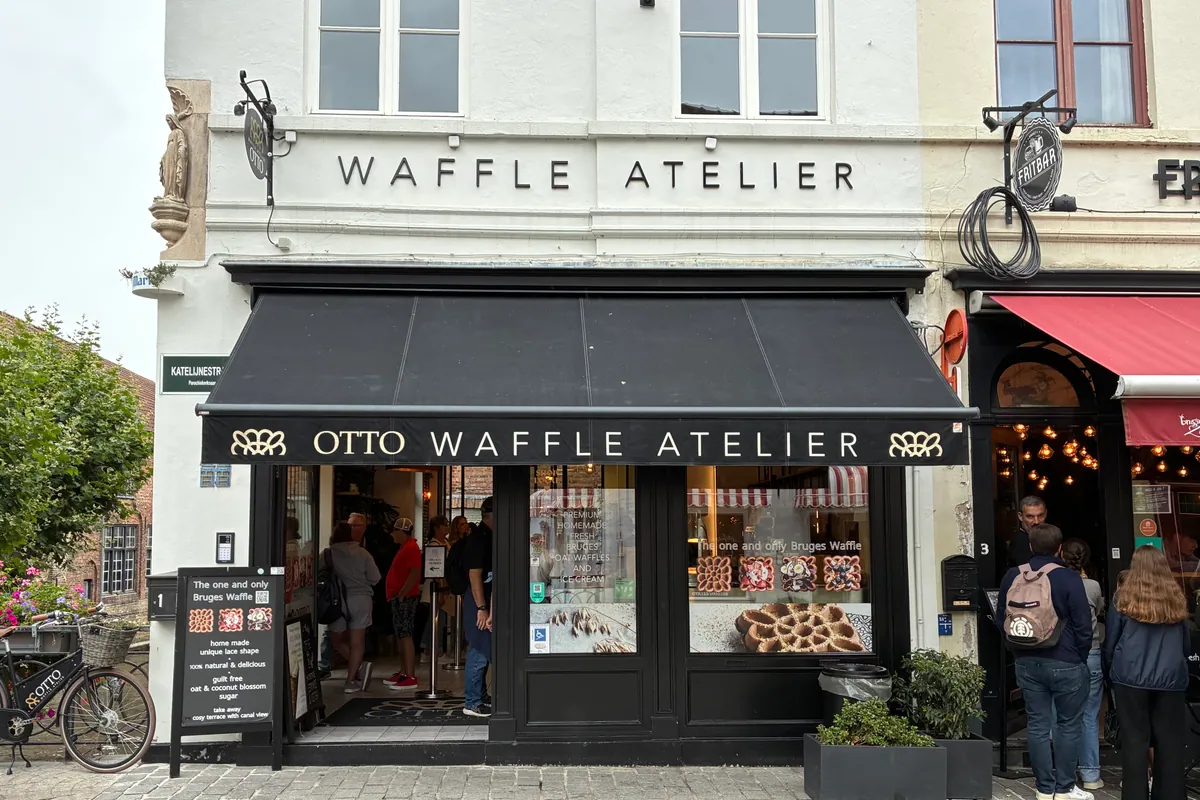
Otto Waffle Atelier at Katelijnestraat 1 is beside the museum quarter, close to the Church of Our Lady and Sint-Janshospitaal. Its Bruges waffles are made to order with organic oats, rapeseed oil and coconut blossom sugar. The business states that every waffle and topping is gluten-free and that the waffles are also dairy-free. A plant-based waffle is available on request.
It is worth visiting for the waffle itself, not merely as an emergency substitute. The oat-based version has its own crisp texture and is the main product rather than a frozen alternative kept aside for special diets.
Otto also warns that allergens may still be unintentionally present despite its procedures. If traces are a concern, explain that you have coeliac disease and ask about the current ingredients, equipment and preparation before ordering.
Best for: a proper Bruges sweet stop, dairy-free travellers and mixed groups with plant-based preferences.
Go.fre: another gluten-free waffle option
Go.fre makes waffles on a stick at Breidelstraat 11 and Katelijnestraat 35. The company says its current waffle dough is gluten-free and oat-free and presents it as suitable for people with coeliac disease or gluten sensitivity.
The remaining question is shared preparation. Public information does not spell out whether irons, chocolate dips, toppings and work surfaces are reserved exclusively for gluten-free production, and some toppings contain biscuits or other ingredients that need individual checking.
That makes Go.fre a useful option, especially near Markt or Katelijnestraat, but ask about shared equipment and the exact topping before relying on it for coeliac disease.
Restaurants where a full meal is possible
Goesepitte 43: plan ahead
Goesepitte 43 asks guests to mention gluten-free, vegetarian, vegan or allergy requirements when booking so that the kitchen can prepare accordingly. Its menu changes with the seasons and suits a planned meal better than an improvised quick lunch.
It is not a dedicated gluten-free restaurant, but advance discussion gives the kitchen a chance to propose something suitable. Put coeliac disease in the reservation and mention it again on arrival.
Ask about bread, sauces, garnishes, surfaces, utensils and whether the proposed menu is suitable for coeliac disease rather than simply wheat-free.
Bohemian Burgers: a practical central fallback
Bohemian Burgers lists a gluten-free vegan bun and a quinoa burger marked both gluten-free and vegan. Other burgers can also be ordered with the gluten-free bun.
The restaurant also handles ordinary bread, breaded products and other gluten-containing foods, so the bun alone does not answer the cross-contamination question. Ask specifically about preparation surfaces, grills, utensils and fries.
Best for: mixed groups that need a straightforward casual meal close to Markt.
’t Pallieterke: traditional food with gluten-free dishes
’t Pallieterke on ’t Zand states that gluten-free dishes are available alongside Flemish food. The website does not identify every suitable dish or describe kitchen separation, so this is one to arrange directly before you go.
Beer-based stews, croquettes, sauces and shared fryers are the obvious points to discuss in a traditional Belgian kitchen.
Chocolate: transparency matters more than appearances
Plain chocolate can have a short ingredient list, but Bruges chocolate shops also handle biscuits, praline fillings, milk, nuts and seasonal products. A dark chocolate shell is not enough evidence that a praline is suitable for coeliac disease.
Sukerbuyc, at Katelijnestraat 5, publishes a filling legend with vegan, vegetarian, lactose, nut and gluten information. Everything is produced on site, and the shop states clearly that cross-contamination with gluten and other allergens cannot be completely excluded.
That makes it a useful place to have a precise conversation. Ask staff to identify the simplest suitable products available that day and explain if traces matter. For severe sensitivity, a sealed packaged product carrying compliant gluten-free labelling is easier to assess than an assorted box assembled from an open counter.
Gluten-free Belgian beer: far more choice than you might expect
Belgian beer is strongly associated with barley and wheat, but the gluten-free range now extends well beyond a single lager. You can find labelled or certified gluten-free blondes, saisons, tripels, a dubbel, kriek, tropical fruit beers and both low- and full-strength options.
In central Bruges, The Bottle Shop at Wollestraat 13 is an especially useful specialist stop. Its gluten-free selection has included names such as SUPER 8 Export, Grisette Blonde Bio, Grisette Citra Hop Bio, FOMO, Slaapmutske, Coucou, Brasvar and Mongozo. Belgian ranges from Vicaris and Brunehaut add still more styles.
Some of these beers are brewed from barley or other gluten-containing cereals and then have gluten reduced or removed during production, so the label on the exact product matters. Our dedicated guide explains the processes, strengths, styles and breweries in detail: see the full guide to gluten-free beer in Bruges.
Questions worth asking in Dutch
A precise sentence is more useful than saying only “no gluten”.
- Ik heb coeliakie. Is dit gerecht glutenvrij en wordt het apart bereid? — I have coeliac disease. Is this dish gluten-free and prepared separately?
- Kan er kruisbesmetting zijn? — Could there be cross-contamination?
- Gebruiken jullie een aparte friteuse? — Do you use a separate fryer?
- Zijn de werkoppervlakken en het keukengerei apart? — Are the preparation surfaces and utensils separate?
- Mag ik de allergeneninformatie zien? — May I see the allergen information?
Belgian restaurants must be able to provide allergen information, although it may be given orally rather than printed on the menu. Asking when you reserve gives everyone more time to answer properly.
A realistic gluten-free day in Bruges
For a lower-stress visit, keep the plan simple:
- Carry a reliable packaged snack for gaps between meals.
- Reserve Goesepitte 43 or another restaurant that has discussed your needs with you in advance.
- Make Otto Waffle Atelier the deliberate sweet stop rather than hoping every waffle shop can improvise.
- Buy chocolate only after an allergen conversation; do not rely on dark colour or “it should be fine”.
- Stop at The Bottle Shop and choose an expressly labelled gluten-free beer from the current selection.
Bruges still has room to improve for coeliac travellers, but the good options are real. The safest approach is to use places that communicate clearly, ask the questions that matter to you and treat current product labels and kitchen procedures as more important than assumptions.