
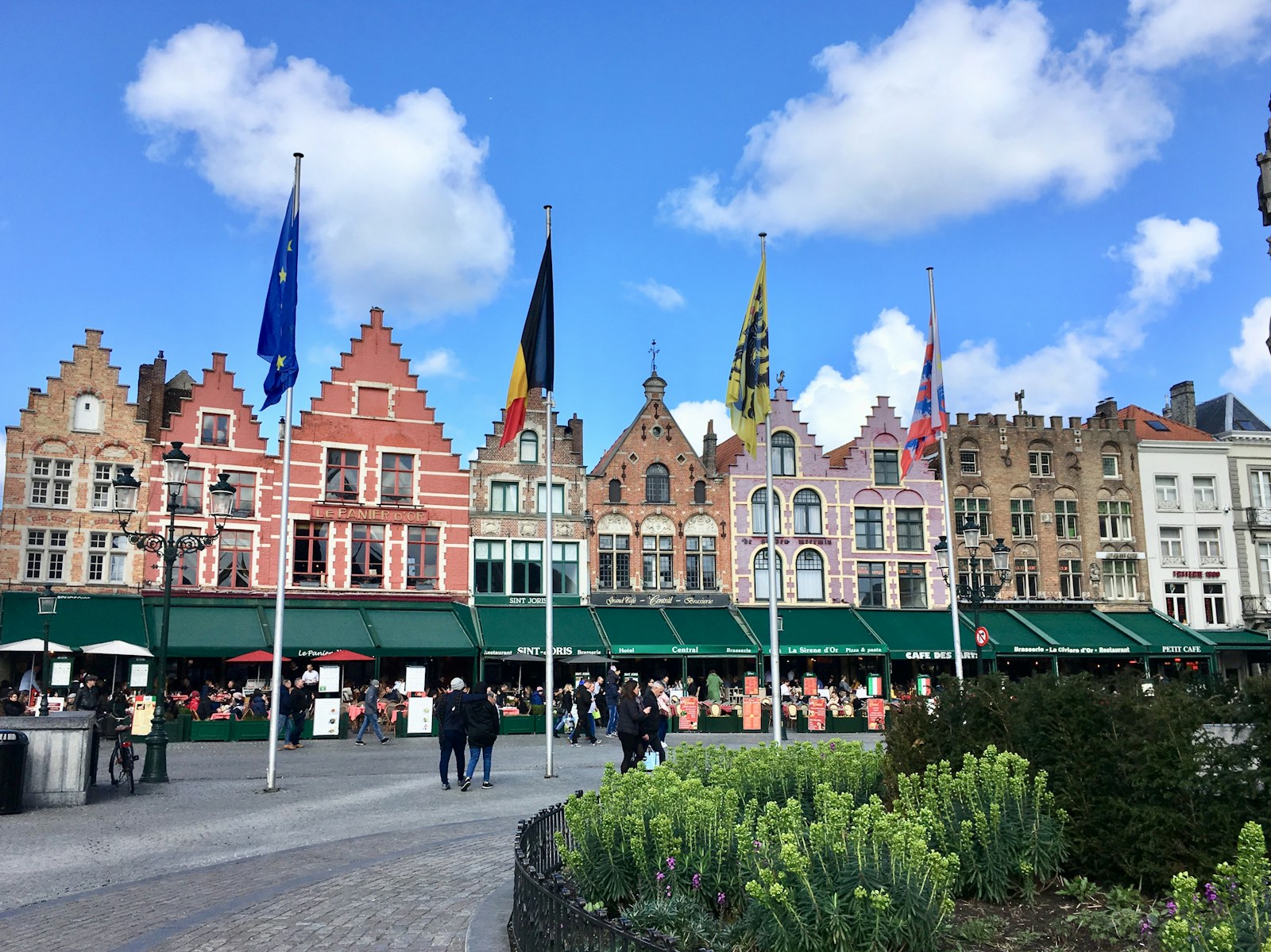
Bruges works surprisingly well with a dog if you plan around one simple fact: “pets allowed” does not mean the same thing everywhere. The city is compact and walkable, several parks and outdoor attractions explicitly welcome pets, and Bruges itself publishes a useful list of businesses that say dogs are welcome. Hotels, however, may still apply room restrictions, size limits or fees even when a tourism listing says pets are accepted.
The easiest trip is therefore one where the essentials are settled before arrival: choose accommodation that explicitly accepts pets, keep a lead with you, know which cafés genuinely welcome dogs, and build the day around outdoor stops rather than assuming every museum, restaurant or boat will admit them.
Quick answer
- Dogs in Bruges: keep them on a lead in public space and pick up after them.
- Hotels: Visit Bruges lists a number of properties with “Pets allowed”, but that does not guarantee every room, every pet size or a fee-free stay.
- Food and drink: Bruges City publishes a current “Dogs welcome” list, including cafés and restaurants that provide water bowls, treats or even a resting place.
- Good outdoor stops: Hof Arents and parts of the city ramparts are among places explicitly listed as allowing pets.
- A boat option: the Lamme Goedzak between Bruges and Damme explicitly allows pets; do not assume the same rule for the regular city-centre canal boats.
- Train: a pet on a lead needs SNCB’s €3 Pet Supplement for a domestic single journey; small pets in a carrier up to 30 × 55 × 30 cm travel free.
- De Lijn bus/tram: pets travel free, with dogs on a lead; the driver can refuse an animal if the vehicle is crowded or the animal causes a nuisance.
- Zeebrugge beach: dog access changes by season, time and beach zone.
- Lost pet: Bruges asks owners to report a lost animal to local police on 050 44 88 44.
Choosing a genuinely pet-friendly hotel
Start with accommodation that explicitly says pets are allowed rather than relying on reviews or a photo of a terrace. Visit Bruges currently marks properties including Hotel De Orangerie, Hotel Portinari, Hotel De Castillion, Hotel Jan Brito, Martin’s Brugge, Hotel Boterhuis, NH Brugge and Hotel De Barge as allowing pets. There are also smaller options such as ardewolf B&B and Charmehotel Bloemenhof.
That label is useful, but it answers only the first question: *may a pet stay here?* It does not automatically tell you whether there is a surcharge, whether all room types accept pets, how many animals are allowed, whether large dogs are accepted or whether bowls and bedding are provided.
Before paying for a non-refundable room, confirm these points in the booking conditions or directly with the property:
- the number and type of pets travelling with you;
- any weight or size restriction;
- the nightly or per-stay pet fee;
- whether pets may be left alone in the room;
- whether breakfast rooms or other common areas exclude animals;
- whether the hotel has a practical place nearby for an early or late walk.
If you are arriving by train, our guide to hotels near Brugge station helps compare locations. A station-area hotel can be especially convenient when you are carrying a pet carrier, bedding or extra luggage.
Cafés and restaurants where dogs are explicitly welcome
Bruges City maintains a “Dogs welcome” directory based on participating local businesses. That is much stronger evidence than assuming a terrace is pet-friendly.
Useful central examples include:
- Café Vlissinghe — water bowl;
- Cavelia — water and dog treats;
- Boho Brunch — water and dog treats;
- Gelateria Da Vinci — even lists dog ice cream;
- ’t Zwaantje — water, treats and a resting place;
- Restaurant Goesting — water and treats;
- The Old Chocolate House — water;
- Sanseveria — water;
- Bohemian Burgers — water;
- Nomad — water;
- Concertgebouw Café — water and treats.
The list is not a promise that every table will always be suitable. A small interior can still be awkward with a large dog, and a busy service may change what is comfortable. But these venues have at least explicitly opted into the city’s dog-welcome list, which makes them a sensible starting point.
Where to walk with a dog
For a first visit, you do not need to leave the historic centre to give a dog a better day than a succession of crowded squares.
Hof Arents
Hof Arents, beside the Church of Our Lady and Boniface Bridge, explicitly lists pets as allowed. It is small rather than a full exercise park, but it makes a useful green pause between major sights.
The ramparts
The green belt around the old city is one of the easiest ways to add a longer walk. Visit Bruges marks places such as Koeleweimolen on the ramparts as pet-friendly. The paths also give you more space than Markt or Steenstraat during the busiest part of the day.
Poertoren and Minnewater area
The park around Poertoren is another useful outdoor stop where pets are allowed. Combined with Minnewater and the southern edge of the centre, it gives you an easy quieter stretch close to the station.
Bruges to Damme by the Lamme Goedzak
If you want an activity rather than another walk, the Lamme Goedzak boat between Bruges and Damme explicitly allows pets. It leaves Bruges from Noorweegse Kaai 31 and follows the Damse Vaart. This is a different service from the short sightseeing boats on the city-centre canals, so do not transfer the pet policy from one operator to another.
Zeebrugge beach with a dog
Zeebrugge can be an excellent dog outing, but the rules are seasonal and spatial.
From 15 March to 15 October, between 10:00 and 19:00, the beach is divided into zones:
- Green zone: from the end of the Zeedijk by the surf club towards the Blankenberge boundary, dogs may be off lead if kept under control.
- Orange zone: near the surf club, dogs must stay on a lead, including in the water.
- Red zone: from the beach cabins towards the St. Georges-Day walk, dogs are not allowed, including in the water.
Outside that date range or outside those hours, dogs are welcome across the full beach and in the water and may be off lead if under control. On the seawall and adjoining streets, keep the dog on a lead. If seals are present on the beach, dogs must also be leashed so they cannot disturb them.
If you are driving to the coast or into Bruges, our Bruges parking guide explains the main city options before you set off.
Train, bus and tram with a pet
SNCB trains
For domestic Belgian trains, SNCB currently charges €3 each way for a pet travelling on a lead. Small pets travel free when carried in a basket, cage or crate no larger than 30 × 55 × 30 cm. Guide and assistance dogs also travel free.
A muzzle is not automatically compulsory on the train, although SNCB recommends one and the train manager can require it. Pets may not sit on seats or tables.
For the human part of the journey, Getting to Bruges covers the main rail and airport routes.
De Lijn buses and trams
De Lijn allows pets free of charge. Dogs should be on a lead and sit on your lap or on the floor; a muzzle may be required when necessary. Small animals should be transported appropriately. The driver may refuse an animal when the vehicle is very crowded or when it is disturbing other passengers.
That makes public transport workable with a dog, but in central Bruges you will often find walking simpler once you have arrived.
Coming to Belgium from abroad
If you are travelling within the EU with a dog, cat or ferret, the standard framework is a microchip (or qualifying older tattoo), valid rabies vaccination and EU pet passport. For a first rabies vaccination, timing matters: the animal must be identified first and the vaccination generally needs a 21-day waiting period before travel.
Rules for animals entering from outside the EU depend on the country of origin and may require an EU animal health certificate and additional conditions. Treat this as border paperwork rather than something to solve after arrival in Bruges.
What if your pet gets lost or needs help?
For a lost animal, Bruges City directs owners to the local police on 050 44 88 44. Save the number before the trip if your dog is prone to bolting, and make sure the microchip registration and the contact details attached to it are current.
For veterinary care, do not assume that a clinic advertising emergency service will accept an unregistered visitor around the clock; some emergency arrangements are limited to existing clients. If your animal has an ongoing condition, carry enough medication, the relevant medical information and the contact details of your own vet or insurer. For urgent care in Bruges, ask your accommodation or a local veterinary practice for the currently available service rather than relying on an old directory entry.
A simple pet-friendly day in Bruges
A comfortable first day could look like this:
- Arrive and settle the luggage first. A hotel that has already confirmed your pet makes the rest of the day much easier.
- Walk through Minnewater and the southern green spaces before heading deeper into the centre.
- Cross the historic core without trying to enter every attraction. Bruges is rewarding from street level, and you avoid repeatedly testing door policies.
- Use a venue from the city’s dog-welcome list for coffee or lunch.
- Add Hof Arents or a ramparts stretch when the central streets become busy.
- Keep one genuinely pet-compatible activity in reserve, such as the Lamme Goedzak to Damme, rather than assuming a standard canal cruise will work.
If you are travelling with both children and a pet, Bruges with children can help you judge pace and family logistics. The same principle works for both: fewer fixed indoor stops and more breathing room usually make the day better.
The main thing to remember
Bruges is not a city where you need to leave your dog behind to enjoy the destination. It is, however, a city where specific permission matters. Use the places that explicitly welcome pets, respect the lead and beach rules, and confirm the exact hotel conditions before booking. That gives you a much more reliable trip than treating “pet-friendly Bruges” as a blanket rule for every business and attraction.