
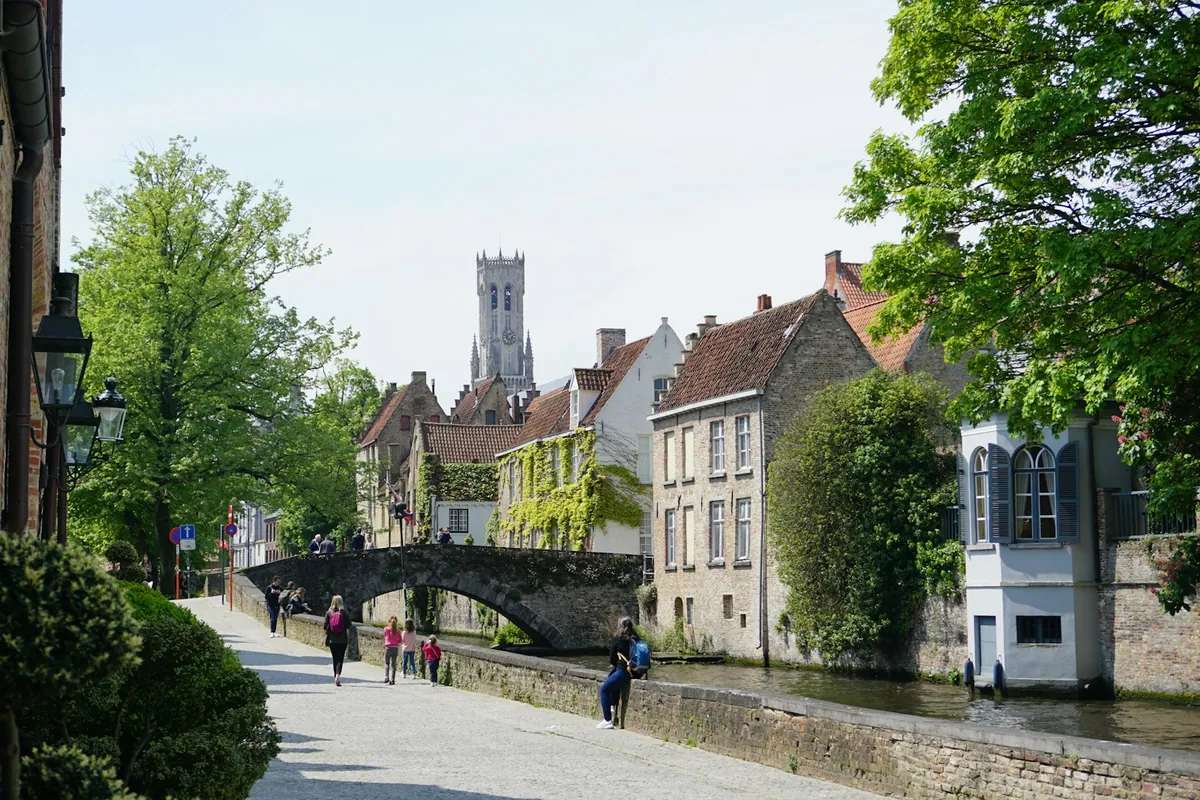


Bruges rewards one simple habit: when a famous view is crowded, walk one street farther. The city is compact enough that a ten-minute detour can change monumental spectacle into gardens, brick walls, quiet water and the sound of ordinary life.
These places are not “secret” in the literal sense. They are documented, cared for and visited. Their charm comes from scale, context and the fact that many day trips never reach them.
For the wider context, begin with what Bruges is and why it matters; for a low-cost route between quieter corners, use our guide to free things to do.
If you would rather explore with stories playing as you walk, The Magic of Bruges on VoiceMap (affiliate-code offer)◆ is a self-guided audio route through medieval streets, alleys, courtyards and lesser-known corners. It is a paid alternative for travellers who want narration and turn-by-turn guidance; the places below remain easy to visit independently.
Jerusalem Chapel and the Adornes Domain
The Adornes Domain is the essential less-obvious visit. The Adornes were an internationally connected merchant family with roots in Genoa. In fifteenth-century Bruges they created a private religious complex whose Jerusalem Chapel drew inspiration from the Holy Sepulchre.
The interior is unlike the city’s larger Gothic churches: vertical, symbolic and intensely personal. A replica of Christ’s tomb, family memorials and the unusual plan communicate private devotion and pilgrimage rather than civic display.
The surrounding domain includes a museum about the family and their world. The story stretches across generations and countries, but you do not need to memorise every name. Let the place feel strange; that is part of its power.
The quiet side of Sint-Anna
From the chapel, continue through Sint-Anna rather than returning immediately to Markt. This eastern quarter mixes churches, modest houses and long views towards the ramparts.
Café Vlissinghe, with documented roots in 1515, makes a good atmospheric pause. It remains a working pub, not a museum set. Nearby streets such as Blekersstraat and Balstraat reward slow looking without requiring a formal attraction.
Windmills on the ramparts
The windmills and Kruisvest ramparts are among the best free experiences in Bruges. The raised green edge marks part of the old fortification line. Windmills stand above the outer canal, and the open ground gives children room to move and adults a wide horizon after narrow streets.
Come in softer morning or evening light. The walk matters more than collecting every mill. Continue far enough to understand that medieval Bruges was enclosed, defended and connected to a landscape beyond its walls.
The courtyard of the Begijnhof
The Princely Beguinage Ten Wijngaerde is famous, yet its inner courtyard can still feel contemplative when visited early and respectfully. Founded in 1245, it was created for a religious community of women; today Benedictine sisters live there.
Keep voices low and remember that this is not merely a white-painted photo location. The entrance bridge, tree-filled garden and restrained façades are most moving when understood as a lived religious space.
Boniface Bridge —at the right moment
Boniface Bridge is not medieval and not hidden. It is, however, genuinely beautiful. The small bridge, Gruuthuse palace, church tower and canal create a compressed romantic scene.
The trick is timing. Visit early, or pass through near closing time for the museums, instead of expecting solitude at midday. Then continue into Arentshof rather than turning the bridge into a photo queue.
The Gruuthuse prayer view
Inside the Gruuthusemuseum (advertising link)◆, a private oratory connected the palace to the Church of Our Lady. The view reveals how wealth, status and religion could be woven physically together. It is a small architectural detail with a larger social story.
This makes Gruuthuse more than a collection of objects. The building itself explains the ambitions of an elite family whose fortune was linked to gruut, the herb mixture once used in brewing.
The garden rhythm around Minnewater
Minnewater is often sold as the “Lake of Love”, but you do not need a legend to enjoy it. The water, bridge, trees and remains of the city’s southern edge make it a natural transition between station and centre.
Walk from the Begijnhof towards the powder tower and return through quieter park paths. In high season, a few minutes away from the main bridge usually restore the calm suggested by the view.
An evening canal without an agenda
After dinner, walk Gouden-Handrei, Sint-Annarei or Groenerei without trying to complete a route. Day visitors have gone, reflections become stronger, and the city’s scale changes.
If you want a drink with the walk, De Garre offers intimacy in the centre, while Café Vlissinghe draws you back towards Sint-Anna. Choose one; the point is not to fill the evening.
A gentle half-day route
- Start at the Adornes Domain and Jerusalem Chapel.
- Walk through Balstraat and pause at Café Vlissinghe.
- Continue to the windmills on Kruisvest.
- Follow the outer canal south, or cut back through Sint-Annarei.
- Finish near Groenerei as late-afternoon light reaches the façades.
The route works because it has one ticketed interior, one neighbourhood pause and a long free walk. That balance is the real charm of Bruges beyond the postcard.