
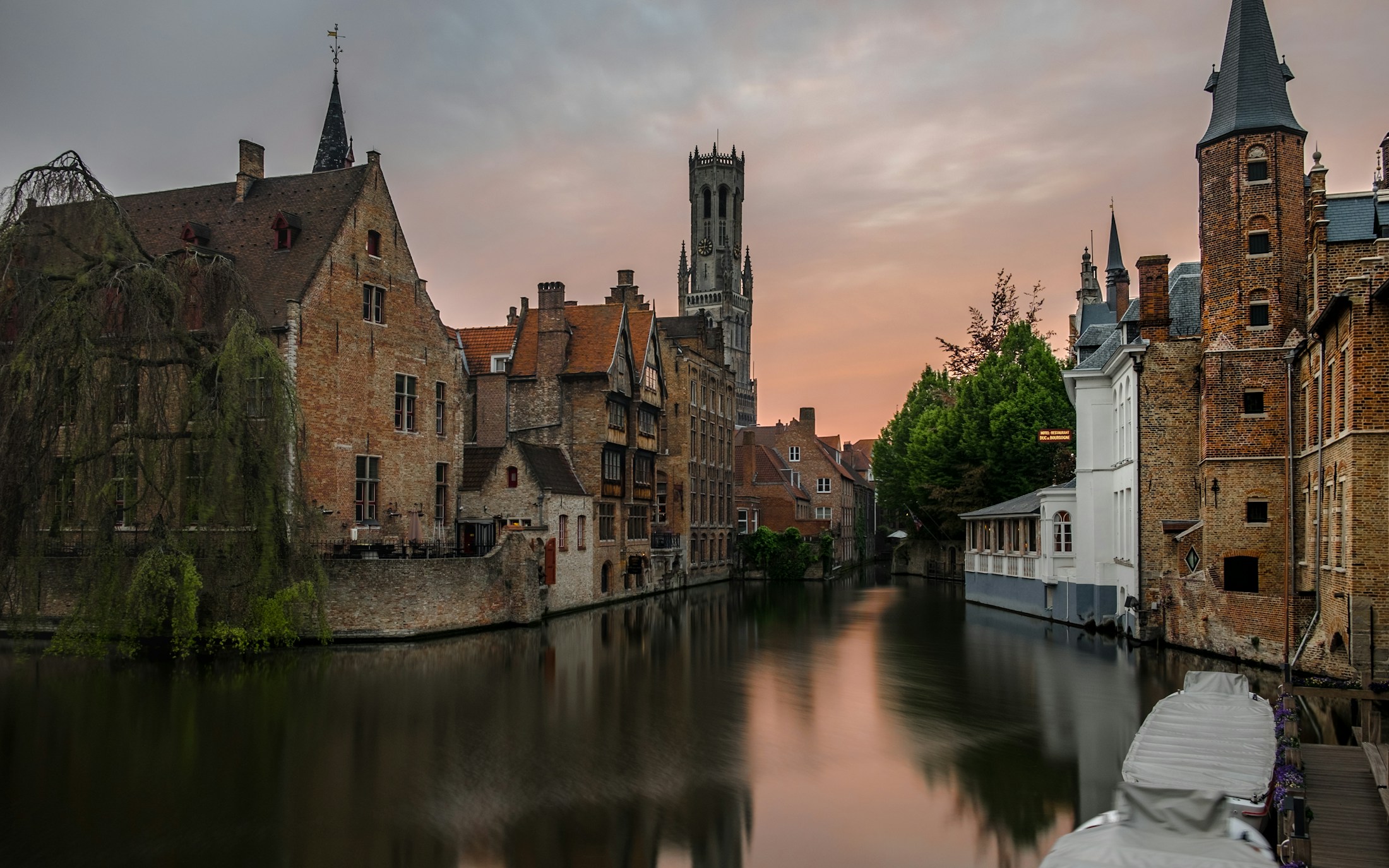
Bruges is a compact historic city in north-west Belgium, the capital of the province of West Flanders. In Dutch it is Brugge; in French and English, Bruges. It lies inland, but its history is inseparable from the North Sea, the tidal waterways that connected it to trade and the later port of Zeebrugge.
For a visitor, the simplest description is this: Bruges is a walkable medieval city whose civic towers, merchant houses, churches, canals and collections still explain how northern Europe became wealthy, urban and artistically ambitious.
Turn that introduction into a route with Bruges in one day, then look beyond the headline sights with our guide to charming places in Bruges.
When did Bruges begin?
There is no single birthday. The earliest documented form of the name dates to 851. A fortified settlement developed in the early ninth century, and Baldwin I established his stronghold here around 863. The place then grew in stages rather than appearing fully formed.
From the eleventh century, cloth production helped Bruges expand. In the thirteenth and fourteenth centuries, merchants from across Europe exchanged wool, textiles, wine, spices and finance here. The city was not a seaport in the modern sense: it depended on a changing network of tidal channels and outports connecting it to the sea.
The Burgundian golden age
The fifteenth century is the Bruges many people imagine. The dukes of Burgundy made the city one of their important residences, court culture attracted craftspeople and patrons, and painters now called the Flemish Primitives changed European art.
See that world at the Groeningemuseum (advertising link)◆, where works by Jan van Eyck and other masters reward slow looking. The Museum Sint-Janshospitaal (advertising link)◆ places Hans Memling’s paintings inside one of Europe’s oldest surviving hospital complexes. At the Gruuthusemuseum (advertising link)◆, domestic luxury and urban history meet in a great city palace.
The city’s political theatre survives too. The Markt is dominated by the Belfry, a symbol of civic confidence rather than a church tower. Nearby, Burg square layers the town hall, former administrative buildings and the Basilica of the Holy Blood into a compact lesson in power and devotion.
Why did Bruges decline?
You may hear that “the canal dried up” and Bruges simply went to sleep. Reality is more complicated. Access to the sea became increasingly difficult, trading patterns shifted and Antwerp grew into the leading commercial centre. Political upheaval also mattered. Bruges lost relative importance, but it did not become an empty museum: people continued to live, work, worship and remake the city.
In the nineteenth century, conservation, tourism and a renewed taste for medieval architecture changed Bruges again. Some buildings are authentically medieval; others were restored or reimagined according to later ideas of what a medieval city should look like. That mixture is part of the story, not a reason to dismiss it.
Bruges today
The historic centre became a UNESCO World Heritage Site in 2000. Yet the best visit goes beyond scenery. Walk east to the windmills and ramparts, enter the unusual Adornes Domain and Jerusalem Chapel, and notice schools, bicycles, gardens and neighbourhood cafés between the monuments.
Bruges also remains a cultural city. BRUSK (advertising link)◆ brings large temporary exhibitions into a contemporary building, while the municipal museum network keeps historic collections connected rather than isolated.
What is Bruges famous for?
- Canals and streetscapes: water offers a different view of bridges, gardens and façades. An official boat trip is useful on a first visit.
- Flemish art: Van Eyck and Memling are not decorative extras; they are central to understanding the city’s international importance.
- Burgundian history: court, diplomacy and ceremony shaped palaces, churches and civic spaces.
- Beer and food culture: breweries such as De Halve Maan and places such as Cambrinus make Belgian traditions approachable without reducing the city to clichés.
- Human scale: the centre is compact enough to explore on foot, provided you leave time for cobbles, queues and unplanned turns.
How long should you stay?
One day reveals the main silhouette; follow our Bruges-in-one-day route if that is all you have. Two nights are much better. They let you see a museum without rushing, experience the centre early and late, and spend time in Sint-Anna after day-trippers have left.
Bruges is beautiful, certainly. More importantly, it is readable. Look beyond the postcard and the city becomes a story about water, trade, civic freedom, devotion, art, reinvention and the stubborn pleasure of a place built for walking.