
Bruges does not demand paid admission every hour. Much of what defines the city—squares, canals, views, ramparts and neighbourhoods—belongs to public space. A limited budget can produce an excellent day if you add context and do not confuse “free” with “unplanned”.
Access to churches, courtyards and activities may change. Respect services, closures and residential space, and follow signs at the site.
Many of these stops overlap with our guide to charming places beyond the postcard, while families can combine them with the pacing advice in Bruges with children.
Markt, the Provincial Court and Burg early
Begin before the tour groups and study Markt’s guild façades. Then go inside the Provinciaal Hof (Provincial Court): general admission is free, not merely the view from the square. The restored neo-Gothic building introduces its own history and West Flanders through its interiors and the `Hof der Dingen` display. The Hofcafé and Hofshop are optional purchases, and current opening times should be checked before visiting.
The Belfry can still be appreciated from outside without a ticket; climbing it is a separate paid choice. Continue to Burg to compare the Gothic town hall, basilica and former government buildings. The two squares represent trade, government and ceremony through very different architecture.
Rozenhoedkaai, Groenerei and the bridges
From Burg, cross Blinde-Ezelstraat and continue to Rozenhoedkaai. Follow Groenerei and Sint-Annarei rather than stopping at one photograph. Reflections and rear façades change with the light.
Boniface Bridge is free and often crowded. If people are queuing for a pose, cross Arentshof and return later. No picture is worth blocking a narrow route.
The Begijnhof and Minnewater
The Begijnhof courtyard asks for quiet because it remains connected to a religious community. White houses and trees make more sense when treated as a living place instead of a set.
Minnewater and its paths provide a green entrance from the station. Move beyond the main bridge to find benches, water and a calmer scale.
Ramparts and windmills
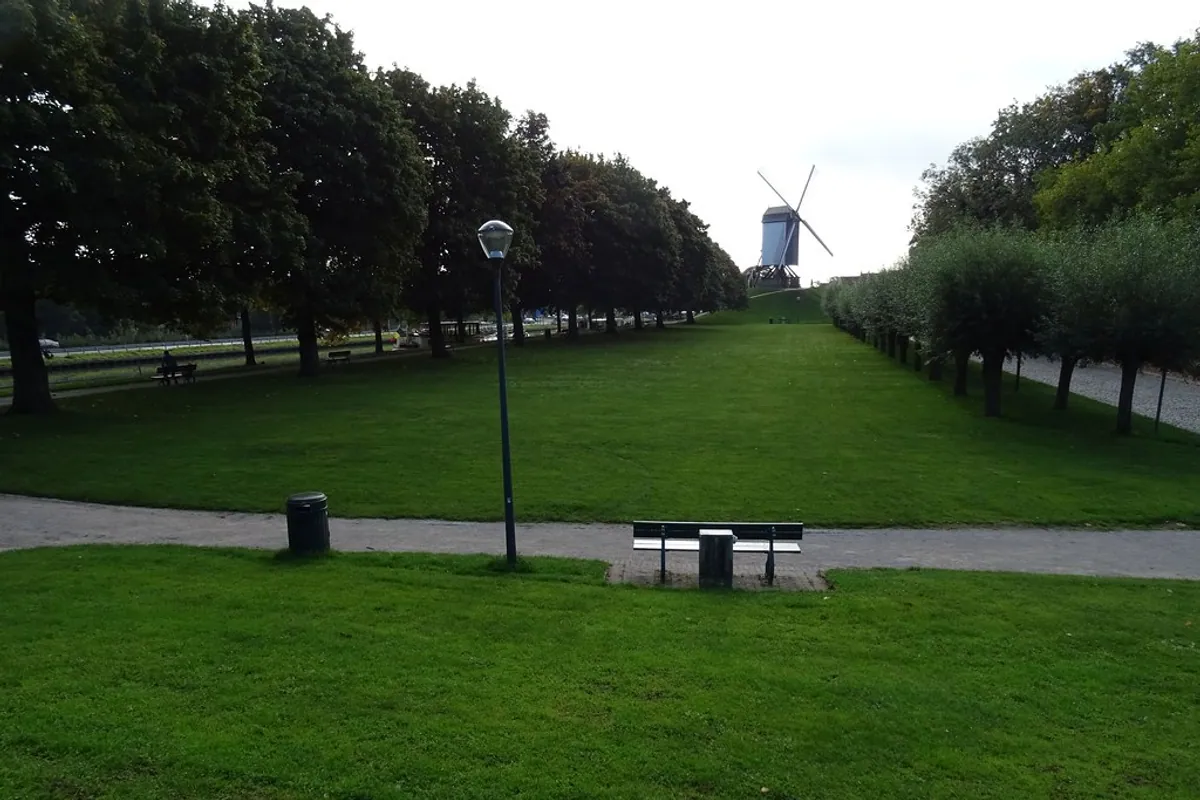
The Kruisvest ramparts and windmills make the best long free walk. The raised green edge follows part of the old defensive line beside the outer canal. There is grass, open perspective and room to rest.
Walk only while it remains enjoyable. The point is not to photograph every mill but to understand the boundary of the historic city.
Sint-Anna without a ticket
Streets around Jerusalem Chapel, Balstraat and Sint-Annarei reveal residential Bruges. You can enjoy the district without entering the Adornes Domain. Modest façades, bridges and small gardens tell another side of the centre.
Churches, parks and events
Some churches allow free access to certain areas outside services, while museum sections may need a ticket. Conditions change; enter respectfully and never interrupt worship.
Koningin Astridpark offers a green pause near Burg. The Old St John site and 't Zand add open public space. Check the current calendar for free places and events on your dates rather than relying on an old listing.
A full free route
- Station, Minnewater and Begijnhof.
- Church of Our Lady exterior, Arentshof and Dijver.
- Rozenhoedkaai, Burg and Markt.
- A simple lunch or responsible picnic.
- Groenerei, Sint-Anna and the windmills.
- Return by the canals near sunset.
Where paying may add real value
One museum or canal boat can provide a perspective the street cannot. Choose by interest: Groeningemuseum for art, Sint-Janshospitaal for Memling and hospital architecture, or the boat for rear façades and gardens from water level.
Saving money does not mean refusing every expense. It means each expense genuinely changes the day.
Free Bruges works because the city is made from relationships between water, brick, power and daily life. Walk slowly, read the space and let one good view last longer than a rushed admission.