
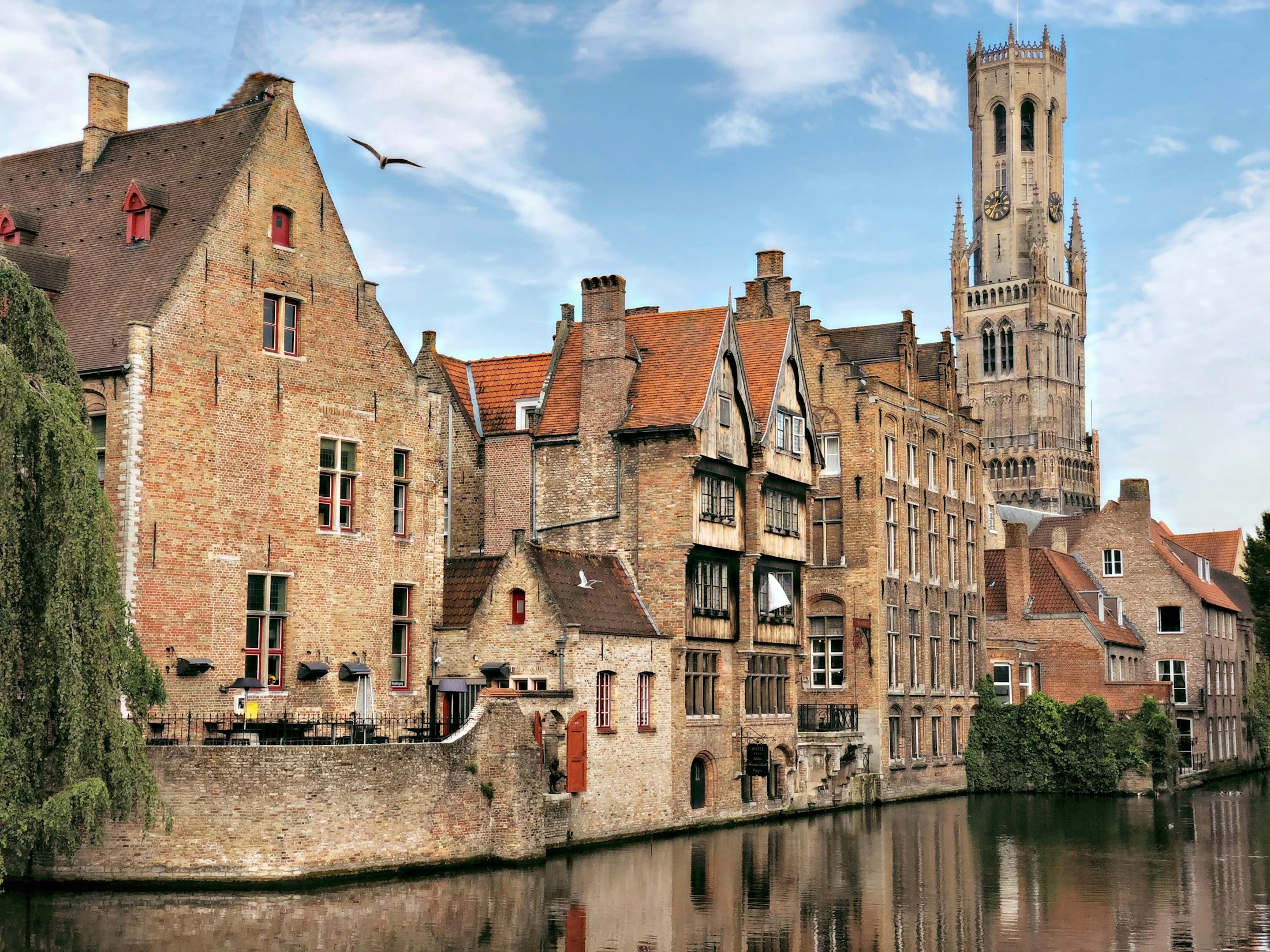


One day in Bruges is enough to understand its shape, but not enough to see everything. The solution is not to walk faster. It is to choose one good viewpoint, one museum, one canal experience and one quieter district.
This route assumes a full day, comfortable walking and arrival near the railway station. Keep the order flexible: museum opening days, boat queues, weather and seasonal events can all change the rhythm without changing the route itself.
If your visit falls between late November and mid-February, check our Bruges Christmas Market and Winter Glow 2026–27 guide before fixing the order of the day. Seasonal programming can change how busy Markt and the historic centre feel, and the Christmas markets themselves end earlier than the wider Winter Glow season.
Travellers with more time can move to the two-day Bruges itinerary; if one collection matters most, choose it first with our Bruges museum guide.
08:30 — Walk through Minnewater and the Begijnhof
From Brugge station, avoid beginning with a bus unless mobility or luggage makes it useful. Walk through Minnewaterpark towards the Begijnhof. The water and trees create a gentler entrance than rushing straight to Markt.
Cross into the Begijnhof quietly. Founded in 1245, the white houses and tree-filled courtyard belong to a living religious setting, not only a photograph. Early morning gives you the best chance to notice its atmosphere.
09:15 — Church of Our Lady and the museum quarter
Continue along Wijngaardstraat and Mariastraat. If Michelangelo and Burgundian history matter most, visit the Church of Our Lady Museum (advertising link)◆. If painting is your priority, reserve your museum time for the Groeningemuseum (advertising link)◆ slightly later.
Pass Boniface Bridge and Arentshof. The bridge is beautiful but small; if it is crowded, keep moving. Bruges offers many better moments than waiting for an empty photograph.
10:15 — Dijver, Rozenhoedkaai and Burg
Follow the Dijver towards Rozenhoedkaai, then turn to Burg. This square concentrates the Gothic town hall, former civic administration and the Basilica of the Holy Blood.
Look at how the buildings compete rather than merely photographing façades. Burg was shaped by power, ceremony and changing architectural taste.
11:00 — Markt and one major viewpoint
Enter Markt and take in the scale before deciding whether to climb the Belfry. The ascent is long and narrow. It is rewarding if you enjoy towers, but it can consume time and energy. If stairs or queues do not suit your day, admire the carillon tower from below and save your attention for a museum.
Do not treat every decorated façade as untouched medieval fabric. Bruges combines medieval buildings with later restoration and historicist reinterpretation. The result is no less meaningful for that.
12:15 — Lunch with a purpose
Choose a proper lunch or something quick, not an accidental hour in the first tourist queue. Cambrinus works well for Flemish classics and Belgian beer near Burg. For bread, pastries or a lighter daytime pause later in the route, Carpe Diem sits near the Begijnhof.
If time is tight, fries followed by chocolate can be enjoyable, but they are not a substitute for all Belgian cooking.
13:30 — See Bruges from the canals
An official canal boat trip is worthwhile on a first visit because from the water you see gardens, bridge arches and rear façades hidden from the street.
The ride is compact. Midday queues can be long, so remain flexible: if the wait is disproportionate, visit your museum first and return later. Weather can affect operations.
14:30 — Choose one museum, not three
For Van Eyck and Flemish painting, choose the Groeningemuseum (advertising link)◆. For Memling, architecture and the history of care, choose the Museum Sint-Janshospitaal (advertising link)◆. For interiors and the life of a wealthy Bruges family, choose the Gruuthusemuseum (advertising link)◆.
Give your chosen museum at least 75–90 minutes. A single collection seen with attention adds more to the day than three rushed visits.
16:15 — Walk east into Sint-Anna
From Burg, follow Groenerei and Sint-Annarei away from the densest streets. If it is open and you still want an interior, the Adornes Domain and Jerusalem Chapel is one of the city’s most distinctive small heritage visits.
Otherwise continue towards the windmills on Kruisvest. The walk is free, green and expansive — the ideal counterweight to Markt.
18:00 — Choose your ending
For beer history, take a pre-arranged visit at De Halve Maan, closer to the Begijnhof. For a quiet historic pub, try Café Vlissinghe in Sint-Anna. For an intimate beer stop in the centre, De Garre hides between Markt and Burg.
Do not cross the city solely to complete this list. Choose the ending closest to where your afternoon naturally finishes.
If it rains
Keep Markt and Burg for short outdoor intervals. Prioritise Sint-Janshospitaal, Groeningemuseum, BRUSK (advertising link)◆, Choco-Story (advertising link)◆ or a brewery. A boat ride may still operate in light rain, but conditions vary.
If you have reduced mobility
Cobbles, bridges and historic buildings require planning. Skip the Belfry climb, check step-free access at the exact museum, and consider local buses between the station and centre. For detailed access planning, use our Accessible Bruges guide.
The route in brief
- Station, Minnewater and Begijnhof.
- Church of Our Lady and Dijver.
- Burg and Markt.
- Lunch and canal boat.
- One museum.
- Sint-Anna or the windmills.
- Dinner or one carefully chosen beer.
The best sign that your day worked is not a full checklist. It is having enough time left to notice the city after the famous sights have stopped demanding your attention.