
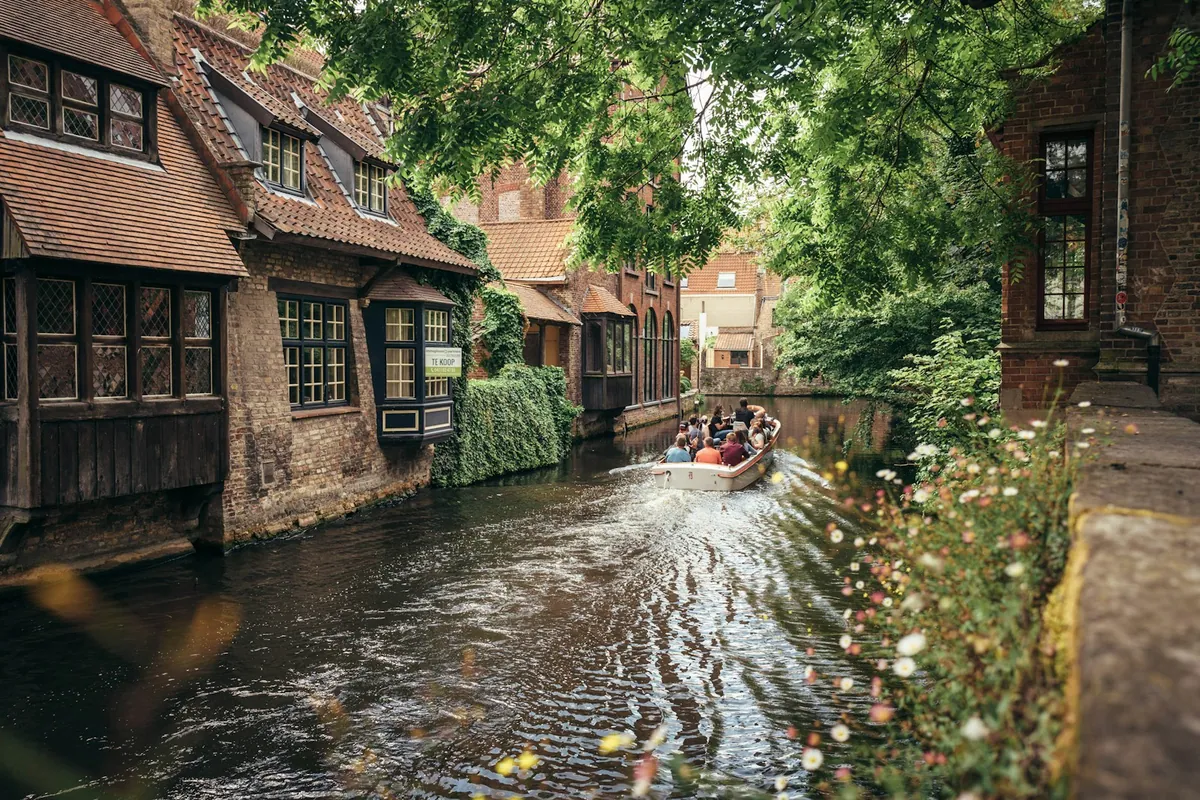


Two days are the sweet spot for Bruges. You can see the celebrated sights without turning them into a race and, crucially, stay after many day visitors have returned to Brussels. This plan assumes two nights or at least two nearly complete days.
Book only what genuinely shapes the day: one museum, a brewery visit or a special dinner. Leave the rest flexible enough for weather, queues and whatever part of the city makes you want to linger.
If your timing changes, use the one-day route as the compact version or the three-day itinerary to slow the pace further.
Day one morning: enter the city from the south
From Brugge station, walk through Minnewater and the Begijnhof. It is a gradual introduction through water, trees and white houses. The Begijnhof courtyard remains a living religious space; enter quietly.
Continue along Mariastraat and through the museum quarter. Cross Arentshof, enjoy Boniface Bridge without expecting it to be empty, then follow Dijver towards Rozenhoedkaai.
Day one midday: Burg, Markt and one tower
Burg brings together the Gothic town hall, former government buildings and the Basilica of the Holy Blood. Move on to Markt and decide whether the Belfry suits you. The climb is demanding and takes time; seeing the tower from below is also a valid choice.
For lunch, resist trying every Belgian emblem at once. Cambrinus is a welcoming introduction to Flemish dishes and Belgian beer. Reserve if it matters to you; otherwise keep one nearby alternative in mind rather than letting lunch dictate the route.
Day one afternoon: canals and a first impression of Bruges
An official canal boat reveals gardens, arches and rear façades hidden from the street. If the queue is long, change the order; the boat should improve the day, not control it.
Then choose one museum. Groeningemuseum (advertising link)◆ is the clear choice for Van Eyck and Flemish painting. Museum Sint-Janshospitaal (advertising link)◆ places Memling inside the story of a medieval hospital.
First evening: look again
Eat near wherever the afternoon ends. Afterwards, walk along Groenerei, Burg or Dijver. At night the distances feel shorter and reflections replace the midday bustle. You do not need another attraction.
Day two morning: choose a different chapter of the city
If day one was about painting, use the second morning for Gruuthusemuseum (advertising link)◆ and the Church of Our Lady. If you have had enough art, choose the intimate Adornes Domain and Jerusalem Chapel, which tells the story of a merchant family connected to a remarkably international 15th-century world.
With children or persistent rain, Historium (advertising link)◆ offers a visual narrative beside Markt. Do not try to fit all three choices in.
Day two afternoon: Sint-Anna and the windmills
Walk east along Groenerei and Sint-Annarei. Pause at Café Vlissinghe if its historic atmosphere appeals, then continue to the Kruisvest windmills. The rampart walk is free, green and spacious.
Active families might prefer a guided bike ride. Travellers who want more context can take a guided walk with a licensed guide instead of buying another ticket.
Second evening: one choice, not a circuit
Finish with a brewery, a meal or chocolate. De Halve Maan offers a structured visit; De Garre, an intimate beer stop in the centre; The Old Chocolate House, a daytime sweet pause. Choose according to appetite and energy.
If it rains or you walk less
- Group Groeningemuseum, Sint-Janshospitaal, Gruuthuse and BRUSK by location rather than crossing the centre repeatedly.
- Replace the windmills with BRUSK (advertising link)◆, Choco-Story or one brewery.
- Use the city bus for the station leg and confirm access at the exact historic building if step-free entry matters to you.
- Allow real time for cobbles, bridges and rests.
In two days Bruges stops being a collection of façades. The first draws the map; the second gives it depth.