
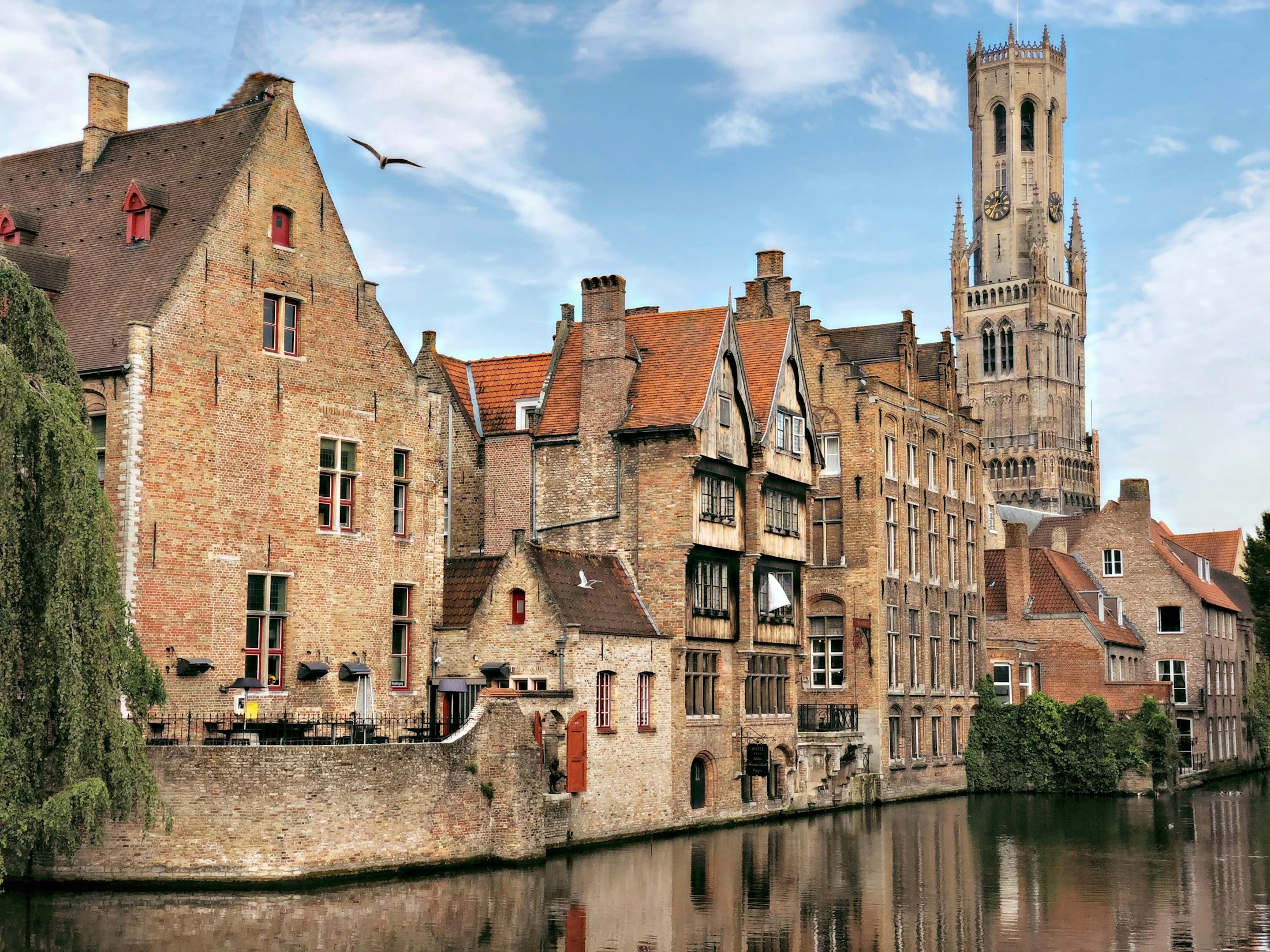
A canal boat is one of the easiest ways to see why Bruges grew around water rather than simply beside it. The standard trip lasts about 30 minutes, follows the same sightseeing route whichever of the five licensed operators you choose, and runs between the Jan van Eyckplein area and the Begijnhof without stops.
The useful part is knowing what the ticket does — and does not — include. This is not a hop-on, hop-off service: you board and return to the same jetty. Individual visitors buy tickets on site rather than reserving a standard seat online, so the best boarding point is usually the one that fits naturally into your walk and has the shortest queue when you arrive.

Quick answer
- Standard trip: about 30 minutes, nonstop.
- 2026 adult price: €15.
- Children aged 4–11: €9; children under 4 travel free.
- European Disability Card: €9; when the cardholder travels with a companion, the companion is free under the current city tariff.
- Five boarding points: Katelijnestraat 4, Nieuwstraat 11, Wollestraat 32, Rozenhoedkaai and Huidenvettersplein 13.
- Route: the same for all five companies.
- March–October: at least daily 10:00–18:00, with last departure at 17:30; operators can adjust for weather and demand.
- November–February: at least one jetty operates daily on a rotating basis.
- Tickets: individual standard tickets are bought on site; no advance online booking for individual passengers.
- Wheelchairs: neither the boats nor boarding points are wheelchair accessible.
- Weather: boats are uncovered; prolonged heavy rain can suspend sailing.
Where can you board a canal boat in Bruges?
There are five official boarding points in the historic centre. All operators follow the same route and use the city tariff, so you do not need to cross Bruges to find a supposedly “better” cruise.
- Rederij Stael — Katelijnestraat 4. Handy if you are coming from the Begijnhof, Minnewater or the station side of the centre.
- Rederij Gruuthuse — Nieuwstraat 11. Convenient for the museum quarter, Church of Our Lady and Dijver.
- Rederij De Meulemeester — Wollestraat 32. A very central option between Markt and Rozenhoedkaai.
- Rederij Coudenys — Rozenhoedkaai. Right in the postcard canal area, so it fits naturally into a first-time sightseeing walk.
- Rederij Venetië van het Noorden — Huidenvettersplein 13. Close to Burg, the Fish Market and the eastern side of the central canal loop.
The practical rule is simple: choose by location and queue, not by route. A ticket from one jetty cannot be used to board at another, and the boat brings you back to the point where you started.
If you are building the ride into a compact sightseeing day, our Bruges in one day itinerary helps place it between the major sights without turning the day into a race.
How much does a Bruges canal boat cost in 2026?
The City of Bruges sets the individual fares. The current prices are valid through 31 December 2026:
- adult: €15;
- child aged 4–11: €9;
- child under 4: free;
- European Disability Card holder: €9;
- companion of an eligible European Disability Card holder: free under the current tariff;
- groups of 20 or more: €12 per person.
For ordinary individual tickets, you pay at the boarding point. The current official information lists cash and Payconiq as payment methods, so carrying a card alone is not the most resilient plan.
Private boats can also be arranged directly with an operator. That is a different product from the normal public departure and is worth considering only for a group that values having the boat to itself.
Can you book tickets online in advance?
Not for a normal individual seat. The official Bruges system currently requires individual visitors to buy at the jetty, and standard seats cannot be reserved online in advance.
That makes queues the main variable. On busy spring and summer days, especially around midday and in the afternoon, you may have to wait for one or more departures. Because the route is identical, walking a few minutes to another jetty can be sensible if the queue in front of you is unusually long — but you still buy and travel from that second operator.
Groups and private boats have separate arrangements with the operators. If you need a guaranteed private departure rather than a standard public seat, the official Bruges boat-trip information lists the current operators and contact details.
What will you see from the water?
The 30-minute circuit runs through the historic canal network between the Jan van Eyckplein side of the centre and the Begijnhof. The pleasure is less about ticking off a sequence of monuments than about seeing Bruges from the level at which its waterways make sense: low bridges, stepped façades, waterside gardens, old quays and views that disappear as soon as you return to street level.
It also changes the scale of the city. Places that feel like separate stops on foot suddenly become parts of one connected water system. For more context on how canals shaped the city’s commercial rise, our guide to Bruges as the Wall Street of the Middle Ages explains the trade world around the former port and Jan van Eyckplein.
When do the boats run?
From March through October, the city guarantees daily service from 10:00 to 18:00, with the last departure at 17:30. Individual operators can still adjust their actual departures according to weather, passenger demand and local circumstances.
From November through February, the system is quieter. At least one boarding point is guaranteed to operate each day through a rotation; the other companies decide whether to sail according to conditions.
There is no advantage in treating 17:30 as a target arrival time. If the boat ride matters to your day, do it earlier and leave the final hour as a buffer for a queue or a weather interruption.
What happens if it rains?
The boats are uncovered. Operators may hand out umbrellas, but a canal trip in persistent rain can be cold and visibility is obviously worse than on a dry day. Prolonged heavy rain can cause temporary suspension of service.
A passing shower is not necessarily a reason to abandon the idea; a genuinely wet afternoon may be. If the weather turns, our Bruges in the rain guide gives you indoor alternatives without wasting the rest of the day.
Is the canal boat accessible?
This is the main limitation. The official accessibility information states that the boats and the embarkation points are not wheelchair accessible. Boarding involves stairs down to the water and there are no lifts.
For visitors who can manage a short transfer and steps with their own companion, Rederij Stael at Katelijnestraat 4 is currently identified as the boarding point with the fewest stairs. That still does not make it wheelchair accessible.
If mobility, step-free access or accessible toilets affect your visit, use our Accessible Bruges guide to plan the rest of the day around verified low-obstacle routes and facilities rather than assuming the boat can be adapted on arrival.
Children, dogs, prams and luggage
The boats carry roughly 35–40 passengers, and the standard trip is short enough to work well for many families. Children under four travel free, while ages 4–11 use the reduced fare.
Small dogs may be accepted if they can sit on your lap, but permission is operator-dependent, so ask at the ticket point before paying. Prams can generally be left aside with the operator while you sail, but there is no promise of secure storage.
There is no room for normal luggage on board. A handbag or small backpack is fine; suitcases are not. If you are visiting between hotel check-out and a train, our Bruges luggage-storage guide is the better solution.
Food and drink are not allowed on the boats.
Which boarding point is best?
There is no universally best jetty because the route and municipal fare are the same. Match the boarding point to the part of town you are already exploring:
- Begijnhof / Minnewater / station side: Katelijnestraat 4;
- museum quarter: Nieuwstraat 11;
- Markt and central shopping streets: Wollestraat 32;
- Rozenhoedkaai photo stop: Rozenhoedkaai;
- Burg / Fish Market: Huidenvettersplein 13.
If two are equally convenient, choose the shorter queue. That is usually more useful than trying to rank the operators themselves.
A good way to fit the boat into your day
For a first visit, late morning or mid-afternoon usually works well: you have already walked enough to recognise parts of the city, but you are not relying on the final departure. Keep roughly 45–60 minutes free rather than exactly 30, because buying the ticket and waiting to board can add time.
The boat is especially worthwhile when you have already seen Bruges from street level. It does not replace walking; it gives the same compact centre a second geometry — and that is the part of the experience that is difficult to reproduce from the pavement alone.